1

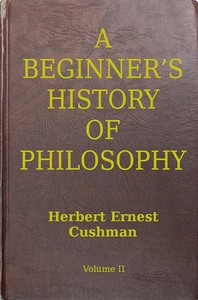
A Beginner's History of Philosophy, Vol. 2: Modern Philosophy — Reading Notes
(0 User reviews)
2221
Project Gutenberg
2020
Not confirmed
Philosophy -- History
Readers of public-domain and historical texts
Project Gutenberg digital edition
en
Edition facts
Words
110,076
Reading time
479 min
Text sections
14
A Beginner's History of Philosophy, Vol. 2: Modern Philosophy — Reading Notes can be approached with a clearer sense of reading commitment from its source measurements: 110,076 words, 7 hr 59 min estimated reading time, and 14 detected text sections.
The text analysis averages about 16.8 words per sentence, while the detected sections provide another way to judge how the source is divided.
Project Gutenberg metadata also associates the work with “Philosophy -- History,” connecting these edition facts with the source record’s subject description.
Source:
Project Gutenberg record #62663
Herbert Ernest Cushman's textbook frames modern philosophy through pedagogical maps and political-literary backgrounds, emphasizing Kant as a pivotal figure and contrasting Hume's historical empiricism with the Scottish School's common-sense reaction.
Read the complete public-domain text at its original source.
Read on Project GutenbergCushman's preface declares the book is written for the student rather than the teacher, aiming to supply an outline that frees class time for the instructor's interpretations. This pedagogical intent shapes the entire volume: each philosopher is situated on a background of geography, contemporary literature, and political history. The excerpts show that Cushman treats Kant as a watershed, calling his teaching 'the beginning of a new movement and a new period,' while the Scottish School is dismissed as a mere reaction with 'no such importance.' The author's own judgments are unapologetically present, as when he praises Hume's 'historical instinct' for grounding religion in feelings rather than reason.
Pedagogical Framing and National Contrasts
Cushman repeatedly uses national schools as organizing units—the Enlightenment, the Scottish School, the German reply to Hume. He draws sharp contrasts: the Enlightenment 'took no account of the past,' whereas Hume 'alone among philosophers shows the historical sense.' The Scottish School is presented as a British reaction to Hume, just as Kant's philosophy was the German one, but Cushman immediately downgrades the Scots: 'The Scottish School has no such importance.' This evaluative hierarchy is part of the textbook's design, guiding the beginner toward what the author considers the main line of development. The preface's stated aim—to make the teacher 'all the more necessary'—is visible in the way Cushman provides condensed judgments that invite classroom elaboration.
Hume as the Exceptional Empiricist
Cushman devotes unusual attention to Hume's departure from Enlightenment norms. He writes that Hume 'alone among philosophers shows the historical sense in the application of his positivism to religion and morals.' The text emphasizes that Hume built ethics on feelings rather than intellect, making reason 'the slave of the passions.' Cushman also notes Hume's critique of deism: religion originated not in reason but in feelings, and the oldest form was idolatry, not natural religion. These observations are tied to specific claims in the excerpts—for instance, that Hume's 'historic sense led him to this conclusion' about moral motives being pleasure and pain. The portrait is of a philosopher who consistently applies empirical method to domains others exempted.
The Scottish School's Alternative Foundation
Thomas Reid's response to Hume is summarized as a rejection of Locke's assumption that the objects of thought are ideas. Instead, Reid held that 'our knowledge starts rather from judgments, which involve certain original truths or natural judgments.' Cushman explains that the Scottish School posited a faculty of 'common sense' that makes these truths a common possession, including self-consciousness, the reality of perceived objects, and the principle of cause. The excerpts show Cushman treating this school as a conservative reaction—'the British reply to Hume'—but one that did not launch a new period. The contrast with Kant's epoch-making status is implicit: the Scottish School corrected Locke but did not advance beyond empiricism.
Kant as the Turning Point
The excerpts position Kant as the culmination of the volume's narrative. Cushman calls his teaching 'the beginning of a new movement and a new period,' in contrast to the Scottish School which 'has no such importance.' The portrait of Kant is introduced with a detailed note about the Puttrich portrait used as a model for Rauch's statue, indicating Cushman's attention to visual and cultural context. While the excerpts do not develop Kant's arguments fully, they establish him as the figure who resolves the tensions between empiricism and rationalism. The textbook's structure—moving from the Enlightenment through Hume and the Scottish School to Kant—reinforces this teleological arc, with Kant presented as the necessary synthesis.
Readers should note that Cushman's judgments are not neutral: he explicitly ranks philosophers by historical significance and dismisses entire schools. The book's value lies in its clear, opinionated framework, which can serve as a starting point for discussion. Because the excerpts are incomplete, the treatment of figures after Kant—such as Hegel or Schopenhauer—is not visible here. The pedagogical apparatus, including maps and references to political history, is designed to make philosophy accessible to beginners, but the author's interpretive choices should be weighed against primary sources.
In Cushman’s volume, Kant sits alone, building his great cathedral of duty from the rubble of Hume’s doubts. I’ve always felt that solitary scaffolding echoed in the essays where older moral certainties gave way to quieter, more personal reckonings. Both books, in their own time, watch a world rearrange itself around a thinking self. There is a fondness in that shared uncertainty, a kinship across the shelf. Our Changing Morality: A Symposium — A Closer Reading holds that same patient breath.
There are no reviews for this eBook.
There are no comments for this eBook.
Reader reflection
Take a moment to reflect on this book
Create a short personal record of your experience with this book.
Your progress
0
/
10
2
What was your overall reaction to the book?
3
Would you recommend this book to another reader?
4
What was the reading difficulty like?
5
How understandable was the text?
6
Would you read this book again?
7
How closely did the book connect with your experience?
8
How useful did the reading feel?
9
What did this book teach you most?
10