1

Chuang Tzu: Mystic, Moralist, and Social Reformer — Themes and Context
(0 User reviews)
791
Project Gutenberg
2019
Not confirmed
Ethics -- China; Philosophy, Chinese
Readers of public-domain and historical texts
Project Gutenberg digital edition
en
Edition facts
Words
115,390
Reading time
502 min
Text sections
40
Chuang Tzu: Mystic, Moralist, and Social Reformer — Themes and Context can be approached with a clearer sense of reading commitment from its source measurements: 115,390 words, 8 hr 22 min estimated reading time, and 40 detected text sections.
The text analysis averages about 14.2 words per sentence, while the detected sections provide another way to judge how the source is divided.
Project Gutenberg metadata also associates the work with “Ethics -- China,” connecting these edition facts with the source record’s subject description.
Source:
Project Gutenberg record #59709
Herbert Giles's 1889 translation of Zhuangzi, with an introduction and notes, presents the Daoist classic through 33 chapters. The excerpts reveal a text blending parables, philosophical dialogues, and critiques of Confucianism, using vivid imagery like skulls and sea-birds to challenge conventional views on life, death, and governance.
Read the complete public-domain text at its original source.
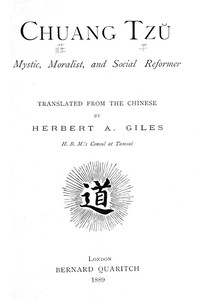
Read on Project GutenbergThe translation opens with a table of contents listing 33 chapters, from "Transcendental Bliss" to "The Empire," and an introduction by Herbert Giles that situates Zhuangzi in the 3rd–4th centuries BCE. Giles notes the historian Ssŭ-ma Ch'ien's observation that Zhuangzi's writings are "mostly allegorical" and aimed to "asperse the Confucian school." The excerpts immediately showcase this allegorical method: a skull debates the merits of death over life, and a sea-bird dies when treated with human rituals. These episodes establish a pattern of using startling images to question fixed categories.
Allegory as Argument
The excerpts demonstrate how Zhuangzi advances philosophical points through narrative rather than abstract reasoning. In one passage, a skull tells Zhuangzi that death offers "happiness greater than that of a king," and refuses rebirth. The translator adds a note: "Reminding us strangely of Hamlet." This moment uses a fictional dialogue to challenge the fear of death. Similarly, the story of the sea-bird—fed wine and music by a prince—dies because it was treated "like oneself, and not as a bird would treat a bird." The moral is explicit: "Being differently constituted, their likes and dislikes are different." These parables do not merely illustrate a point; they are the argument itself, forcing the reader to reconsider assumptions about nature and custom.
The Role of Confucius
Confucius appears in several excerpts, but not as a revered sage. In one, he is saddened by Yen Yüan's journey to the state of Ch'i, fearing the disciple will preach the "Tao of Yao and Shun" to a prince who will not understand and may kill him. Confucius quotes Kuan Chung: "Small bags won't hold big things; short ropes won't reach down deep wells." The passage uses Confucius to critique the Confucian impulse to instruct rulers. Giles notes that "several sentences of the above are clearly in imitation of parts of ch. ii" and calls the episode "beyond doubt a forgery." This editorial comment highlights the text's layered composition and the translator's willingness to question authenticity.
Transformation and Relativity
A recurring theme in the excerpts is the fluidity of forms and the relativity of perspectives. Lieh Tzŭ, eating by the roadside, points at a skull and says, "Only you and I know that there is no such thing as life and no such thing as death." The passage continues with a sequence of transformations: germs become duckweed, then lichen, then dog-tooth violet, then grubs, then butterflies, then insects, then birds. This chain of metamorphoses undermines fixed identities. The translator's note on the skull dialogue—"Who can say whether what we call death may not after all be life, and life death?"—reinforces the theme. These passages invite the reader to see the world as a process of endless change, where categories like life and death are merely provisional.
The Translator's Voice
Herbert Giles's presence is felt throughout the excerpts. He supplies footnotes identifying historical figures (e.g., "Kuan Chung, Prime Minister to Duke Huan of the Ch'i State, 7th century B.C.") and clarifying ambiguous phrases (e.g., "Lit. 'he will die.' But the verb 'to die' is often used in the sense of 'to make to die'"). He also offers literary judgments, comparing a skull's speech to Hamlet and labeling a Confucius episode a "forgery." These interventions shape how a first-time reader encounters the text: Giles is not a neutral conduit but an interpreter who guides, annotates, and occasionally disputes. Readers should be aware that the translation reflects late-Victorian scholarly conventions and Giles's own interpretive choices.
As you read, attend to the interplay between parable and commentary. Zhuangzi's arguments often emerge from the collision of voices—a skull, a bird, Confucius, Lieh Tzŭ—rather than from systematic exposition. Giles's notes provide historical context but also reveal his own biases. Treat the translation as a dialogue between an ancient Daoist text and a 19th-century British sinologist. The excerpts offer a taste of the work's wit and strangeness; the full text rewards patience with its layered ironies.
I keep thinking about that Zhuangzi translation, how a skull could speak so gently about rest. It’s the same quiet ache I felt flipping through A Philosophical Dictionary, Volume 04 — A Reader’s Guide—not answers, just older voices wondering aloud. Some pages stay with you like a friend’s hand on your shoulder, long after you’ve closed the book.
There are no reviews for this eBook.
There are no comments for this eBook.
Reader reflection
Record your reading impressions
A brief reflection can help important ideas stay with you longer.
Your progress
0
/
10
2
What was your overall reaction to the book?
3
Would you recommend this book to another reader?
4
What was the reading difficulty like?
5
Was the book moving at the right speed?
6
What did you appreciate most?
7
Did it raise ideas you would like to talk about?
8
Did this book create an emotional response?
9
In one sentence, what did you learn?
10