1

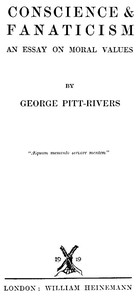
Conscience & Fanaticism: An Essay on Moral Values — Edition Insights
(0 User reviews)
248
Project Gutenberg
2018
Not confirmed
Ethics; Conscience; Fanaticism
Readers of public-domain and historical texts
Project Gutenberg digital edition
en
Edition facts
Words
31,969
Reading time
139 min
Text sections
4
This digital edition of Conscience & Fanaticism: An Essay on Moral Values — Edition Insights is described by source-level measurements including 31,969 words, 2 hr 19 min estimated reading time, and 4 detected text sections.
The text analysis averages about 29.5 words per sentence, while the detected sections provide another way to judge how the source is divided.
Project Gutenberg metadata also associates the work with “Ethics,” connecting these edition facts with the source record’s subject description.
Source:
Project Gutenberg record #58136
An examination of fanaticism as a mental state, drawing on early 20th-century psychology and philosophy to analyze conscience, suggestion, and the subjective mind, with references to hypnotism and race memory.
Read the complete public-domain text at its original source.
Read on Project GutenbergGeorge Pitt-Rivers opens his 1919 essay with a frank admission of presumption, acknowledging the many better-qualified writers who have tackled moral values before him. The preface sets a cautious, almost apologetic tone, yet the work proceeds to build a systematic argument about fanaticism as a dangerous mental state. Pitt-Rivers draws heavily on contemporary psychology, particularly the laws of suggestion and autosuggestion as observed in hypnotism, to explain how conscience can be subverted. The catalog subjects—Ethics, Conscience, Fanaticism—accurately reflect the essay's concerns, though the excerpts show a stronger reliance on empirical psychology than on traditional moral philosophy.
The Subjective Mind and Suggestion
Pitt-Rivers devotes considerable space to the subjective mind, which he describes as amenable to suggestion and autosuggestion. He cites Hudson's view that the subjective mind accepts statements unhesitatingly, even absurd ones, and uses hypnotic experiments as evidence. For instance, a subject told he is a dog will act the part, and one told he is Napoleon will perform with fidelity. The author extends this to moral contexts: a devout Catholic cannot be hypnotized into violating his creed, suggesting that ingrained autosuggestions resist external influence. This framework is central to his theory of conscience, which he wryly defines as 'literally self-knowledge—but in practice more often lack of self-knowledge.' The excerpts do not reveal whether Pitt-Rivers fully reconciles this psychological model with traditional ethical systems, but the emphasis on hypnotism is striking for a work cataloged under Ethics.
Race Memory and Telepathy
In a brief but notable passage, Pitt-Rivers invokes race memory to explain instinctive behaviors, citing ducklings that make for water despite being raised by hens. He also mentions telepathy as a normal means of communication between subjective minds en rapport, suggesting that subconscious emanations may be mistaken for messages from another world. These references indicate a willingness to incorporate speculative psychology into his moral analysis. The catalog subjects do not prepare the reader for such topics; the essay appears to blend ethics with early 20th-century psychical research. The excerpts do not clarify how these ideas connect to fanaticism, but they hint at a broader argument about the irrational foundations of belief.
The Structure of the Argument
The preface outlines a two-part structure: earlier portions examine moral ideas, later ones focus on facts of nature and mind. Pitt-Rivers aims to keep the argument free of philosophical dialectic, preferring common usage. He acknowledges heavy reliance on past and contemporary writers, both those he agrees with and those he opposes. The excerpts show a methodical, citation-heavy style, with references to Hume, Moll, and Hudson. The author's stated purpose is to guard against catastrophes beget by fanaticism, yet the excerpts do not reveal specific historical examples or conclusions. Readers should expect a theoretical treatise rather than a polemic, grounded in psychology but reaching toward moral philosophy.
Pitt-Rivers's essay is best approached as a document of its time, engaging with psychological theories that were then cutting-edge. The catalog subjects provide a starting point, but the text ranges into hypnotism, telepathy, and race memory. Readers interested in the intersection of ethics and early psychology will find the most value here; those seeking a conventional moral treatise may be surprised by the empirical turn. The author's humility in the preface is a useful guide: this is a tentative exploration, not a definitive system.
Reading about suggestion and the weight of inherited conscience, I remembered sitting beside my grandfather while he quietly described a war he never discussed otherwise. His silence spoke louder than any argument. Years later, Ethics — Part 1 — Context and Discussion gave that memory a shape, showing how moral certainty can harden into something almost geological, pressing down slowly.
There are no reviews for this eBook.
There are no comments for this eBook.
Reader reflection
Before you leave, reflect on the book
Use these questions to collect your thoughts before moving on.
Your progress
0
/
10
2
Was reading this book enjoyable?
3
Is this a title you would suggest to others?
4
Did the language feel accessible?
5
Did you relate to its people, ideas, or situations?
6
Was the book what you thought it would be?
7
Could you apply anything you learned?
8
Which part made the strongest impression?
9
What is the main idea you are taking away?
10