1

German philosophy and politics — Text and Context
(0 User reviews)
289
Project Gutenberg
2013
Not confirmed
Philosophy, German
Readers of public-domain and historical texts
Project Gutenberg digital edition
en
Edition facts
Words
29,491
Reading time
129 min
Text sections
4
The catalog record for German philosophy and politics — Text and Context provides practical reading context through 29,491 words, 2 hr 9 min estimated reading time, and 4 detected text sections.
The text analysis averages about 24.4 words per sentence, while the detected sections provide another way to judge how the source is divided.
Project Gutenberg metadata also associates the work with “Philosophy, German,” connecting these edition facts with the source record’s subject description.
Source:
Project Gutenberg record #42208
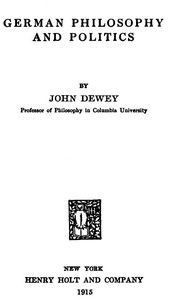
John Dewey's 1915 lectures examine how German idealist philosophy—Kant, Fichte, Hegel—shaped political thought and national identity, arguing that abstract ideas like the 'two worlds' and the state as a moral organism had concrete effects on German culture and politics.
Read the complete public-domain text at its original source.
Read on Project GutenbergDewey opens with a paradox: the more humans gain practical control over nature, the more they doubt that ideas influence action. He calls this a 'troubled question' and notes that when people had least control, they were most confident in thought's efficacy. The first lecture, 'German Philosophy: The Two Worlds,' sets up a dualism between an ideal realm and the empirical world—a framework Dewey traces through Kant and his successors. The excerpts show Dewey treating philosophy not as abstract speculation but as a force with political consequences, especially in Germany's unification and its sense of mission.
Ideas as Political Forces
Dewey insists that general ideas are not idle. He writes that a discovery proving thought has no influence would itself be an idea that influences affairs—a self-refuting claim. This rhetorical move establishes his core argument: philosophy matters for politics. He cites the German case where, after Napoleon, 'spiritual and ideal Germany made common cause with realistic and practical Prussia.' The excerpts include a long quotation from Von Sybel describing how Kant, Schiller, Goethe, Fichte, and Humboldt fueled resistance to French domination. Dewey uses this to show that intellectual culture directly supported state-building. He does not claim that ideas alone caused unification, but that they provided a moral and spiritual rationale that aligned with Prussian political interests.
The State as Moral Organism
In the second lecture, Dewey examines German moral and political philosophy. He quotes a source saying 'the concept of the State must be broadened so as to make the State the contrivance whereby all human virtue is to be realized to the full.' This reflects the Fichtean and Hegelian view that the state is not merely a legal apparatus but the embodiment of ethical life. Dewey notes that Fichte's system can be called an 'ethical pantheism and monism,' though he cautions that such labels are not very enlightening. Instead, he uses them to point to a 'spiritual temper' in early nineteenth-century Germany—a conviction that the nation had a cultural mission. The excerpts show Dewey connecting this philosophy to the labor movement: he mentions that some thinkers argued workingmen should lead in developing the state's true functions.
History as a Germanic Philosophy
The third lecture turns to the philosophy of history. Dewey draws on the commonplace among German historians that national development 'started from the most ideal and approximated more and more to the real.' He quotes Lange to this effect and links it to the idea that Germany's unity was 'wrought from within outward.' The excerpts include Heine's remark that Germany was assigned 'the kingdom of the clouds' after Napoleon's defeat, but Dewey argues that this aerial kingdom became a 'mighty power' working with Prussian statesmen. He does not endorse this narrative uncritically; rather, he presents it as a self-understanding that had real effects. The lecture appears to examine how German thinkers constructed a historical teleology that justified political expansion and cultural superiority.
Dewey's lectures are best read as an inquiry into the practical consequences of philosophical ideas, not as a history of German thought. He selects and interprets evidence to show how abstract doctrines—dualism, the state as moral organism, historical mission—shaped a national consciousness. Readers should attend to Dewey's own method: he treats philosophy as a social force, and his argument is as much about the role of ideas in general as about Germany specifically. The excerpts are incomplete, but they reveal a sustained effort to bridge theory and practice.
That rainy afternoon, Dewey’s account of how Kant’s stern duty and Hegel’s grand system quietly seeped into German life left me uneasy—the cost of such tidy ideals. I set it down, gazing at the wet window, and drifted instead toward older questions. My hand found A Short History of Greek Philosophy — Story, Setting & Ideas, and the room felt lighter, the rain less weighty. Some seekers, I thought, simply asked what the good life was, before the state demanded the answer.
There are no reviews for this eBook.
There are no comments for this eBook.
Reader reflection
Take a moment to reflect on this book
Create a short personal record of your experience with this book.
Your progress
0
/
10
2
How did the book work for you overall?
3
How likely are you to recommend this book?
4
How much effort did this book require?
5
What was its emotional impact?
6
Did the book deliver what you hoped for?
7
Did the book give you something worth debating?
8
Was the book easy to understand?
9
What did this book teach you most?
10