1

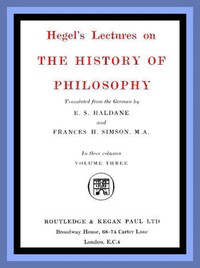
Hegel's Lectures on the History of Philosophy: Volume 3 (of 3) — A Closer Reading
(0 User reviews)
456
Project Gutenberg
2018
Not confirmed
Philosophy -- History
Readers of public-domain and historical texts
Project Gutenberg digital edition
en
Edition facts
Words
190,417
Reading time
828 min
Text sections
41
The source record for Hegel's Lectures on the History of Philosophy: Volume 3 (of 3) — A Closer Reading measures this digital text at 190,417 words, 13 hr 48 min estimated reading time, and 41 detected text sections.
The text analysis averages about 21.7 words per sentence, while the detected sections provide another way to judge how the source is divided.
Project Gutenberg metadata also associates the work with “Philosophy -- History,” connecting these edition facts with the source record’s subject description.
Source:
Project Gutenberg record #58169
Hegel's third volume traces philosophy from medieval scholasticism through modern thinkers like Locke, analyzing how each system advances the self-realization of Spirit. The excerpt on Locke exemplifies Hegel's method: he dissects Locke's empiricism, arguing that its focus on 'being-for-another' fails to grasp the universal implicit in thought.
Read the complete public-domain text at its original source.
Read on Project GutenbergHegel's third volume of his lectures on the history of philosophy moves from medieval scholasticism to modern philosophy, with a sustained focus on how each system contributes to the self-realization of Spirit. The excerpt on John Locke exemplifies Hegel's critical method: he dissects Locke's empiricism, arguing that its insistence on 'being-for-another' fails to grasp the universal implicit in thought. Hegel contrasts Locke's nominal essences with the Notion, asserting that 'the implicit is the universal.' The passage reveals Hegel's characteristic movement between close textual analysis and sweeping metaphysical judgment.
Structure: From Medieval to Modern
The volume's organization mirrors Hegel's dialectical progression. Part Two covers the Middle Ages, subdivided into Arabian philosophy, Scholasticism, and the Revival of the Sciences. Part Three opens Modern Philosophy with Bacon and Jacob Boehme, then moves to the 'Period of the Thinking Understanding,' where Locke appears under 'Metaphysics of the Understanding.' This placement is telling: Locke is treated not as an empiricist but as a metaphysician of the understanding, a stage in the development of thought. The transition from medieval to modern is marked by the Reformation, which Hegel sees as a shift in the principle of subjectivity.
Recurring Images: The Implicit and the Universal
Throughout the Locke excerpt, Hegel returns to the opposition between the 'implicit' (an sich) and 'being-for-another' (für Anderes). He charges Locke with declaring the moment of 'for-another' unreal while seeking truth only in that relation. This binary recurs in Hegel's critique of nominalism and empiricism: the universal is dismissed as a mere product of mind, yet the mind's activity is itself overlooked. Hegel's own image of the 'litany' wearies of hearing—'Das Innere der Natur kennt kein erschaffener Geist'—underscores his impatience with the claim that we cannot know real essence.
Movement Between Scenes: From Locke to the Notion
Hegel's analysis moves fluidly between Locke's text and his own speculative framework. He cites Locke's argument that species are not absolute, using the example of monstrosities, then counters that nature 'signifies the lack of power to be perfectly adequate to the Notion.' The movement is from empirical observation to dialectical reversal: what Locke takes as proof of the non-absoluteness of species becomes, for Hegel, evidence that the Notion exists only in spirit. This pattern—taking an opponent's point and transforming it into a step toward absolute knowing—characterizes Hegel's lecture style throughout the volume.
Voice and Rhetorical Strategy
Hegel's voice in the Locke section is combative and evaluative. He declares that 'Locke is far back in the nature of knowledge, further back than Plato.' Such direct comparisons are typical: Hegel measures each philosopher against the standard of speculative truth. He also uses rhetorical questions and dismissive phrases—'the same litany which has since been so constantly repeated'—to align his audience against the errors of empiricism. Yet he acknowledges Locke's contributions to 'general culture' (education, toleration, natural rights), showing a nuanced judgment that separates philosophical merit from historical influence.
Readers approaching this volume should attend to Hegel's method of immanent critique: he does not simply refute earlier philosophers but shows how their positions generate contradictions that propel thought forward. The Locke excerpt is a microcosm of this process. To follow Hegel's argument, trace how each thinker's central concept—whether 'being-for-another' or 'nominal essence'—is taken up and sublated into a higher determination. The volume rewards careful reading of its transitions, where the movement between systems reveals the logic of Spirit's self-development.
That gray afternoon, Hegel’s dissection of Locke’s stubborn empiricism left me restless—his insistence that the universal hides within thought felt like a door left ajar. Rain blurred the window, and I reached, almost absently, for an old edition of Marcus Aurelius. The emperor’s quiet self-examination seemed to answer Hegel’s abstraction with a familiar, human pause. I found Meditations — Context and Discussion resting beside it, and understood.
There are no reviews for this eBook.
There are no comments for this eBook.
Reader reflection
Before you leave, reflect on the book
Use these questions to collect your thoughts before moving on.
Your progress
0
/
10
2
Did this book hold your interest?
3
Would you encourage someone else to read it?
4
How demanding did the text feel?
5
What was its emotional impact?
6
How original did the book feel?
7
How understandable was the text?
8
How useful did the reading feel?
9
What is the main idea you are taking away?
10