1

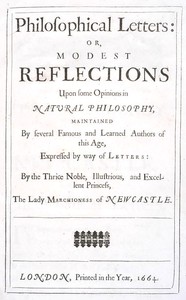
Philosophical Letters: or, modest Reflections upon some Opinions in Natural Philosophy — Reading Notes
(0 User reviews)
109
Project Gutenberg
2016
Not confirmed
Philosophy; Newcastle, William Cavendish, Duke of, 1592-1676
Readers of public-domain and historical texts
Project Gutenberg digital edition
en
Edition facts
Words
155,893
Reading time
678 min
Text sections
18
Philosophical Letters: or, modest Reflections upon some Opinions in Natural Philosophy — Reading Notes can be approached with a clearer sense of reading commitment from its source measurements: 155,893 words, 11 hr 18 min estimated reading time, and 18 detected text sections.
The text analysis averages about 65.2 words per sentence, while the detected sections provide another way to judge how the source is divided.
Project Gutenberg metadata also associates the work with “Philosophy,” connecting these edition facts with the source record’s subject description.
Source:
Project Gutenberg record #53679
Margaret Cavendish's 1664 'Philosophical Letters' presents a series of epistolary critiques of contemporary natural philosophers, including Hobbes, Descartes, and Van Helmont. Cavendish challenges their theories on matter, life, and spirit, often highlighting obscurity and logical inconsistencies. The letters reveal her own materialist and vitalist views, emphasizing the inseparability of matter and motion.
Read the complete public-domain text at its original source.
Read on Project GutenbergMargaret Cavendish's Philosophical Letters (1664) is a work of sustained critical engagement with the leading natural philosophers of her day, including Thomas Hobbes, René Descartes, and Jan Baptist van Helmont. Writing in the form of letters to an unnamed correspondent, Cavendish dissects their arguments with a mixture of deference and pointed skepticism. The book's subtitle—'modest Reflections'—belies the sharpness of her critiques, as she repeatedly calls out obscurity, logical gaps, and what she sees as unwarranted metaphysical claims. The letters are not a systematic treatise but a series of targeted interventions, each focusing on a specific problem or concept. Cavendish's own philosophical commitments emerge through her criticisms: she defends a materialist and vitalist view of nature, where matter is self-moving and perceptive, and she rejects any sharp division between body and spirit. The epistolary format allows her to adopt a conversational tone while maintaining rigorous argumentation, making the work both accessible and demanding.
Critiquing Obscurity: Cavendish's Method of Close Reading
Cavendish frequently complains that the authors she examines are 'obscure, mystical and intricate' in their expressions. In Letter XI, she confesses her inability to understand Van Helmont's concept of a 'middle life,' listing multiple possible interpretations—between strongest and weakest, between production and dissolution, or between animal and angel—before concluding that she will 'leave this Hermaphroditical or neutral life to better understandings.' This passage illustrates her method: she does not dismiss an idea outright but first tries to parse it, exposing its ambiguity by showing the range of possible meanings. She applies the same scrutiny to the notion of 'Ideas' as 'certain seminal Images, Formal Lights, and operative means,' questioning how something without substance can 'pierce, seal, and print a figure.' By insisting on clarity and logical consistency, Cavendish positions herself as a rigorous reader who demands that philosophical terms be anchored in coherent definitions.
Matter, Motion, and the Rejection of Immaterial Causes
Throughout the letters, Cavendish defends the view that matter is inherently active and perceptive. She challenges the idea that immaterial spirits or ideas can cause physical effects, arguing that 'there can be no figure without matter or substance, they being inseparably united together.' In her critique of Van Helmont's Archeus, she notes that generation 'by overshadowing' is only known from the miraculous conception of the Virgin Mary, and she warns against comparing the Archeus to the Holy Spirit. This reveals her commitment to natural explanations that do not invoke supernatural or immaterial agents. She also rejects the notion that seed dies in the fruit, insisting instead that it 'lives rather in the fruit, and is numerously increased.' For Cavendish, life and motion are intrinsic to matter, not imposed from without. Her materialism is thus a vitalist one, where all parts of nature possess their own motion and perception.
The Epistolary Form as Philosophical Strategy
The choice of the letter format is not merely stylistic but strategic. Cavendish addresses her letters to 'Madam,' a fictional correspondent who has presumably asked for her opinions on various authors. This framing allows her to adopt a posture of modesty—she is only responding to a request—while nevertheless advancing bold criticisms. She often begins by acknowledging her own 'ignorance' or 'disability of conceiving' an author's meaning, only to then dismantle their arguments. The epistolary form also enables her to move quickly between topics, as each letter can focus on a single point without needing to build a continuous system. The table of contents shows that the work is divided into four sections, each containing multiple letters, suggesting a cumulative but not linear argument. This structure reflects Cavendish's view of philosophy as an ongoing dialogue rather than a finished doctrine.
Readers approaching Philosophical Letters should be prepared for a dense, argumentative text that rewards careful attention to Cavendish's specific objections. It is helpful to have some familiarity with the authors she critiques—particularly Hobbes, Descartes, and Van Helmont—but her arguments are largely self-contained. The letters can be read selectively, as each addresses a distinct issue. Cavendish's own positive views emerge piecemeal, so reading across multiple letters is necessary to reconstruct her philosophical system. The work is a valuable record of a seventeenth-century woman's engagement with the scientific revolution, offering insights into both the content and the rhetoric of early modern natural philosophy.
I keep thinking about how Cavendish wrote to philosophers she admired, yet still pushed back so gently. It reminded me of that older Roman calm, where reflection matters more than winning. There's something similar in Seneca's Morals of a Happy Life, Benefits, Anger and Clemency — A Reader’s Guide, that quiet insistence on inner steadiness. Both linger like a long exhale after a hard day.
There are no reviews for this eBook.
There are no comments for this eBook.
Reader reflection
Record your reading impressions
A brief reflection can help important ideas stay with you longer.
Your progress
0
/
10
2
How much did you enjoy the reading experience?
3
Would you recommend this book to another reader?
4
How much effort did this book require?
5
Did any part of the book feel personally relevant?
6
How clearly were the main ideas presented?
7
What did you appreciate most?
8
How useful did the reading feel?
9
What changed or sharpened your thinking?
10