1

The game of life and how to play it — Context and Discussion
(0 User reviews)
1903
Project Gutenberg
2024
Not confirmed
Conduct of life; New Thought; Spirituality; Success -- Psychological aspects
Readers of public-domain and historical texts
Project Gutenberg digital edition
en
Edition facts
Words
24,995
Reading time
109 min
Text sections
14
The source record for The game of life and how to play it — Context and Discussion measures this digital text at 24,995 words, 1 hr 49 min estimated reading time, and 14 detected text sections.
The text analysis averages about 18.2 words per sentence, while the detected sections provide another way to judge how the source is divided.
Project Gutenberg metadata also associates the work with “Conduct of life,” connecting these edition facts with the source record’s subject description.
Source:
Project Gutenberg record #74878
Florence Scovel Shinn's 1925 manual frames life as a game governed by spiritual laws, using biblical quotations and case studies to argue that imagination, speech, and emotional states directly shape external circumstances.
Read the complete public-domain text at its original source.
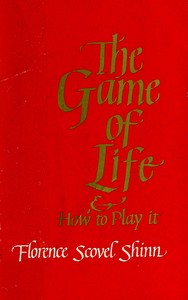
Read on Project GutenbergFlorence Scovel Shinn opens The Game of Life and How to Play It by rejecting the common view of life as a battle, instead proposing it as a game whose rules are laid out in the Old and New Testaments. The central mechanism she describes is a law of return: whatever a person sends out in word or deed comes back. She illustrates this with a brief anecdote of a man who feared a rare disease, pictured it continually, and eventually died from it—a cautionary tale about the power of the imagination, which she calls “The Scissors of The Mind.” Shinn divides the mind into three departments—subconscious, conscious, and superconscious—and asserts that the subconscious, though powerful, has no direction of its own; it simply executes whatever is deeply felt or clearly imaged.
Imagination as a Creative Force
Shinn repeatedly emphasizes that the imagination is not merely fanciful but causal. She writes that “what man images, sooner or later externalizes in his affairs,” and supports this with the biblical injunction to “Keep thy heart (or imagination) with all diligence.” Her vocabulary for this faculty is striking: she calls it “The Scissors of The Mind,” cutting day by day the pictures a person holds, which eventually appear in the outer world. The anecdote of the man who died from picturing a rare disease is offered as proof that even fearful images can manifest. Shinn does not treat imagination as passive daydreaming; she insists it must be trained deliberately to image only good, thereby bringing health, wealth, love, and perfect self-expression.
The Subconscious as Unquestioning Servant
Shinn describes the subconscious mind as “simply power, without direction,” comparable to steam or electricity. It has no power of induction; it merely carries out what it is directed to do. This mechanistic view underpins her entire system: if a person feels something deeply or images it clearly, the subconscious will execute it “in minutest detail.” She illustrates this with the example of a woman who, as a child, “made believe” she was a widow, dressing in black and wearing a long veil. The implication is that such early imaginative play could shape later reality. Shinn’s language here is precise and functional, avoiding mysticism in favor of a quasi-scientific model of mental operation.
Love as a Cosmic Phenomenon
In the chapter titled “Love,” Shinn shifts from mechanics to emotion, calling love “a cosmic phenomenon” that opens the fourth-dimensional world. She defines real love as selfless and free from fear, pouring itself out without demanding return. Jealousy, she warns, is the worst enemy of love because it causes the imagination to run riot, objectifying fears. She recounts a case study: a woman whose lover left her for others. Shinn’s advice is to give a perfect, unselfish love and to bless the man wherever he is, even when the woman initially refuses. The turning point comes when the woman says, “God bless the Cap wherever he is,” and soon after the man proposes. Shinn presents this as a miracle, but her narrative emphasizes the woman’s internal work—ceasing to be disturbed—as the cause.
The Teacher in Every Encounter
Shinn introduces a maxim: “No man is your enemy, no man is your friend, every man is your teacher.” This frames interpersonal conflict as a lesson rather than a battle. She advises becoming impersonal and learning what each person has to teach, after which one becomes free. In the love chapter, the woman’s lover is described as “teaching her selfless love.” Shinn also references a brotherhood in India that greets each other with “I salute the Divinity in you,” a practice she recommends to see only the divine self in others. This perspective aligns with her broader system: by controlling one’s own reactions and perceptions, one changes the external situation. The emphasis is on internal discipline, not on manipulating others.
Shinn’s prose is direct and anecdotal, relying on biblical authority and personal case studies rather than abstract philosophy. Readers should note that her claims are presented as practical laws, not hypotheses; the excerpts offer no counterexamples or qualifications. The book’s structure—short chapters with titles like “The Law of Nonresistance” and “Casting the Burden”—suggests a manual to be applied, not merely read. For those interested in early twentieth-century New Thought literature, this text exemplifies a confident, instructional voice that treats spiritual principles as self-evident and immediately actionable.
Flowing through Scovel Shinn’s game, I kept noticing how she treats each thought as a move, a quiet wager on the unseen. That notion lingered, reminding me of an old favorite where logic, too, felt like a living experiment, not a fixed rule. Both books hum with the same gentle trust: that our inner actions ripple outward, slowly, like Essays in Experimental Logic — Key Ideas to Explore tracing its own patient, uncertain path.
There are no reviews for this eBook.
There are no comments for this eBook.
Reader reflection
Record your reading impressions
A brief reflection can help important ideas stay with you longer.
Your progress
0
/
10
2
How did the book work for you overall?
3
Would you pass this book on to a friend?
4
How easy was the book to follow?
5
How valuable was this book for your own interests?
6
Would a second reading be valuable?
7
Did you relate to its people, ideas, or situations?
8
What did you appreciate most?
9
What is the main idea you are taking away?
10