1

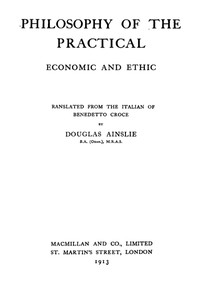
The Philosophy of the Practical: Economic and Ethic — Inside the Classic
(0 User reviews)
284
Project Gutenberg
2017
Not confirmed
Ethics; Economics; Will
Readers of public-domain and historical texts
Project Gutenberg digital edition
en
Edition facts
Words
132,769
Reading time
578 min
Text sections
19
For The Philosophy of the Practical: Economic and Ethic — Inside the Classic, the stored edition analysis reports 132,769 words, 9 hr 38 min estimated reading time, and 19 detected text sections.
The text analysis averages about 32.8 words per sentence, while the detected sections provide another way to judge how the source is divided.
Project Gutenberg metadata also associates the work with “Ethics,” connecting these edition facts with the source record’s subject description.
Source:
Project Gutenberg record #54938
Benedetto Croce's systematic argument that economic activity is an autonomous form of the spirit, distinct from morality, examined through his precise diction, polemical structure, and use of historical examples like Hegel on repentance.
Read the complete public-domain text at its original source.
Read on Project GutenbergCroce opens his argument by asserting that economic activity constitutes an autonomous form of the spirit, a claim he had first advanced in essays from 1897 to 1900. The text's diction is consistently technical and polemical: Croce speaks of 'reducing' the philosophy of law to the philosophy of economy, and he frames his project as a systematic treatment rather than a mere collection of essays. His sentences are long and hypotactic, packed with qualifications and references to other thinkers, which signals a work intended for an audience already versed in philosophical debate.
The translator, Douglas Ainslie, inserts his own preface praising Croce's 'potent influence,' but the body of the work itself avoids such rhetoric. Croce's voice is direct and combative, as when he dismisses certain concepts as 'derived' or 'empirical.' The excerpts show a philosopher who builds his case through careful distinction and historical critique, not through appeal to sentiment.
Polemical Structure and Diction
Croce's prose is shaped by a persistent polemical stance. He does not merely state his own position; he defines it against others. In the excerpts, he targets Herbart, Kant, Schiller, Spinoza, and Hegel, often using the phrase 'it would be possible to demonstrate' to introduce a counter-argument. His diction is precise and evaluative: Herbart 'was in the right against Kant, but he afterwards let the axe fall on his own feet.' The metaphor is striking and reveals Croce's willingness to use vivid, even violent, imagery to make a philosophical point. He also employs Latin quotations from Spinoza without translation, assuming a learned readership. The structure of his paragraphs often follows a pattern: state a position, introduce an opponent's view, then dismantle it with logical or historical reasoning. This creates a rhythm of assertion and rebuttal that drives the argument forward.
The Concept of Economic Autonomy
Central to the work is the claim that economic activity is 'an autonomous form of the spirit.' Croce's phrasing here is deliberate: he does not say 'independent' or 'separate,' but 'autonomous,' a term that carries connotations of self-legislation. This choice reflects his broader idealist framework, in which spirit manifests itself in distinct but interrelated forms. The excerpts show him applying this concept to the philosophy of law, which he seeks to 'reduce' to the philosophy of economy. The word 'reduce' is not pejorative in his usage; it means to trace back to a more fundamental principle. Croce's argument is that moral concepts like duty and remorse are 'derived' from the will, not original. He supports this by citing Herbart's critique of Kant, but then turns Herbart's own method against him. The reader must follow these dialectical moves closely, as Croce rarely pauses to summarize.
Hegel on Repentance and the Magdalen
One of the most vivid passages in the excerpts is Croce's extended quotation from Hegel on repentance and remorse. Hegel, Croce reports, 'instituted a regular persecution of the concept of repentance and remorse.' The word 'persecution' is strong and suggests Croce's disapproval. Hegel's own language, as quoted, is caustic: he speaks of 'lamblike gentleness,' 'vile and listless gentleness,' and 'sad creatures' who are like 'lice and parasitic plants.' Croce then turns to Hegel's remarks on the Magdalen in Italian painting, where Hegel finds that 'sin in her is as seductive as conversion.' Croce does not explicitly endorse or reject Hegel's view here; he presents it as an example of how a philosopher's contingent historical concerns can shape his theoretical judgments. The passage illustrates Croce's method of using concrete cultural references to test abstract concepts. The reader is left to weigh Hegel's critique against Croce's own defense of repentance as a 'necessary negative moment.'
Translator's Framing and the British Audience
Douglas Ainslie's translator's preface provides a revealing frame for the work. He declares that 'Great Britain has long been a country where moral values are highly esteemed' and that the British are 'experts in the practice, though perhaps not in the theory of morality.' This remark suggests that Ainslie sees Croce's book as filling a lacuna in British thought. He also notes that he has chosen to place this volume before the Logic in the English edition, even though it is third in the original Italian series. His justification—that 'philosophy is like a moving circle, which can be entered equally well at any point'—is itself a philosophical claim. The preface includes quotations from Italian critics de Ruggiero and Natoli praising Croce's system as 'the most powerful effort' and 'the highest conquest' of contemporary thought. These endorsements, while not by Croce himself, shape the reader's expectation of encountering a major work. Ainslie's voice is confident and promotional, contrasting with Croce's more austere tone.
Readers approaching this text should be prepared for a demanding, closely argued work that assumes familiarity with German idealism and Italian philosophy. Croce's sentences are dense and his references wide-ranging; the excerpts suggest that he expects the reader to follow his dialectical moves without hand-holding. The translator's preface offers a useful orientation, but the real work lies in tracking Croce's distinctions between economic and moral activity. The book rewards careful reading, especially in its use of historical examples to test theoretical claims. Those interested in the philosophy of action, the relation between ethics and economics, or the history of idealist thought will find much to engage with.
Croce’s insistence that economics follows its own logic, untouched by moral judgment, reminds me of how lives quietly unfold without our approval. On Compromise — Themes and Context sits beside it on my shelf, whispering that even our half-hearted concessions carry their own stubborn integrity. I find myself thinking of both often, like old friends who never quite agreed.
There are no reviews for this eBook.
There are no comments for this eBook.
Reader reflection
What was your reading experience?
Capture what you thought, learned, and would like to remember.
Your progress
0
/
10
2
Was reading this book enjoyable?
3
Is this a title you would suggest to others?
4
How much effort did this book require?
5
How understandable was the text?
6
How original did the book feel?
7
Would you like to discuss this book with someone?
8
Is this a title worth rereading?
9
What did this book teach you most?
10