1

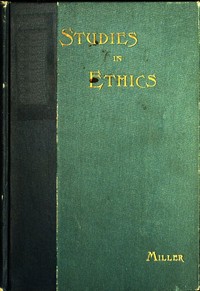
Short Studies in Ethics: An Elementary Text-Book for Schools — Context and Discussion
(0 User reviews)
1192
Project Gutenberg
2013
Not confirmed
Ethics
Readers of public-domain and historical texts
Project Gutenberg digital edition
en
Edition facts
Words
28,363
Reading time
124 min
Text sections
4
The source record for Short Studies in Ethics: An Elementary Text-Book for Schools — Context and Discussion measures this digital text at 28,363 words, 2 hr 4 min estimated reading time, and 4 detected text sections.
The text analysis averages about 19.8 words per sentence, while the detected sections provide another way to judge how the source is divided.
Project Gutenberg metadata also associates the work with “Ethics,” connecting these edition facts with the source record’s subject description.
Source:
Project Gutenberg record #43439
This editorial note examines the authorial choices in Rev. J. O. Miller's 1895 textbook, focusing on diction, dialogue, and description in excerpts on duty, patriotism, and bodily exercise.
Read the complete public-domain text at its original source.
Read on Project GutenbergRev. J. O. Miller's Short Studies in Ethics (1895) opens each chapter with a direct, declarative definition—"Duty is something which is due"—then immediately pivots to a moral judgment: "No other word is more disliked by the slothful." This pattern of definition followed by character assessment recurs throughout the excerpts, revealing a pedagogical voice that blends categorical instruction with personal exhortation. Miller addresses his readers as "a boy or man of that kind," implying a classroom of male students and a teacher who knows their resistance firsthand.
Definition as Moral Lever
Miller's method is to state a principle, then apply it through contrast. In the Duty chapter, he writes that the word itself "causes weariness to a boy or man of that kind"—the slothful. The remedy is not argument but habit: "accustoming ourselves to perform it regularly, a little at a time." This technique appears again in Bodily Exercise, where a dramatic anecdote of two swimmers—one who drowns, one who survives by "swim and then float, and rest himself, and breathe"—illustrates the difference made by "exercise, or the steadiness of training." The moral is embedded in the narrative, not stated abstractly.
Patriotism as Deed, Not Cry
In the Patriotism chapter, Miller distinguishes between empty cheering and productive citizenship. He quotes the proverb that the truest patriot "can make two blades of corn grow where only one grew before," then applies it to Canada: "Our country does not at this stage of its history require the partisan, or the politician; we have too many of them." The voice is that of a headmaster addressing future citizens, urging them to love their country "as men love their homes and families." The chapter closes with Ruskin on sacrifice, reinforcing the idea that patriotism is a "sacred duty" proven by deeds, not slogans.
The Teacher's Voice and Audience
Miller's preface reveals that the book "grew out of periodical addresses to my own pupils" and is designed to "supplement Bible instruction." The excerpts consistently address a young male reader: "No boy ever grew to manhood with a fairer heritage than the young Canadian possesses." The tone is authoritative yet personal, mixing classical references (Plato's Greek epigraph) with contemporary examples (Sir John Lubbock's statistics). Miller's diction—"slothful," "flabby muscles," "weak lungs"—carries a moral weight that equates physical neglect with character failure.
Structure and Repetition
Each chapter follows a predictable arc: a crisp definition, an illustrative anecdote or quotation, and a direct application to the reader's life. In Bodily Exercise, Miller cites Dr. Hall's story of the canoe accident, then generalizes: "Exercise makes the body strong." He then offers a testimonial about a young man who, after regular training, could lift his brother overhead. The pattern is didactic but varied—sometimes using historical figures (Tennyson, Ruskin), sometimes hypothetical cases. This structural consistency suggests a textbook designed for weekly half-hour lessons, as Miller states in the preface.
Moral Physiology
Miller repeatedly links physical health to moral virtue. In Bodily Exercise, he claims that neglect "keeps the muscles weak, makes the blood impure, and renders the body liable to diseases." The implication is that a weak body reflects a weak will. This connection is explicit in the Duty chapter, where sloth is both a physical and moral failing. The excerpts do not show Miller addressing girls or women, and the examples are uniformly masculine—canoeists, soldiers, young men with dumb-bells. The book's moral universe is one where character is built through disciplined action, and where the body is a site of ethical training.
Miller's Short Studies in Ethics is best read as a period document of late-Victorian moral instruction, where definition, anecdote, and exhortation work together to shape character. Readers should note how the author's choices—from the direct address to the recurring link between physical and moral health—reflect a specific pedagogical context: a Canadian boys' school in 1895. The excerpts offer a window into that world without revealing the full arc of the book's twenty-four chapters.
In Miller’s careful little book, I see a man wrestling with duty as a quiet, daily thing—much like Averroes, centuries earlier, who found in faith and reason not foes but patient neighbors. That kindred spirit of gentle inquiry has stayed with me, a fond echo between their pages, across all my years of shelving and reading. The Philosophy and Theology of Averroes — Background and Themes holds a similar hush, a thoughtful pause that feels almost like a hand resting on a worn cover.
There are no reviews for this eBook.
There are no comments for this eBook.
Reader reflection
Record your reading impressions
A brief reflection can help important ideas stay with you longer.
Your progress
0
/
10
2
How did the book work for you overall?
3
How likely are you to recommend this book?
4
How easy was the book to follow?
5
Did you gain anything practical from the text?
6
What did you appreciate most?
7
Did you relate to its people, ideas, or situations?
8
Would a second reading be valuable?
9
What changed or sharpened your thinking?
10