1

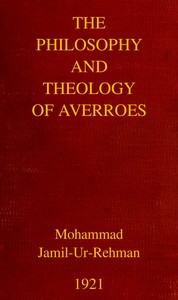
The Philosophy and Theology of Averroes — Background and Themes
(0 User reviews)
1280
Project Gutenberg
2021
Not confirmed
Philosophy, Arab; Islam and philosophy
Readers of public-domain and historical texts
Project Gutenberg digital edition
en
Edition facts
Words
55,214
Reading time
241 min
Text sections
12
This digital edition of The Philosophy and Theology of Averroes — Background and Themes is described by source-level measurements including 55,214 words, 4 hr 1 min estimated reading time, and 12 detected text sections.
The text analysis averages about 24.2 words per sentence, while the detected sections provide another way to judge how the source is divided.
Project Gutenberg metadata also associates the work with “Philosophy, Arab,” connecting these edition facts with the source record’s subject description.
Source:
Project Gutenberg record #65708
This editorial note examines Averroes' argumentative diction and theological reasoning in his treatises on religion and philosophy, focusing on his use of scriptural evidence, logical distinctions, and the translator's framing of the text.
Read the complete public-domain text at its original source.
Read on Project GutenbergAverroes' treatise on the relation between religion and philosophy opens with a decisive rhetorical move: he declares that the Law commands the study of philosophy, grounding his claim in Quranic verses that urge reflection on the universe. The translator, Muhammad Jamil-ur-Rehman, presents the work as a direct translation from the Arabic edition by D. H. Muller, emphasizing that Averroes should 'speak for himself.' This editorial note examines the authorial choices visible in Averroes' diction, his handling of scriptural evidence, and the logical structure of his arguments, particularly in the section on divine direction.
Averroes' Use of Scriptural Citations
Averroes repeatedly anchors his arguments in Quranic verses, but his selection and framing reveal a deliberate strategy. In the excerpt on divine direction, he cites verses about the Throne, the governance of affairs, and the angels' ascent, then notes that 'if interpreted, would turn the whole of the Law into interpretation.' This phrasing underscores his concern with maintaining the exoteric sense for the masses while allowing allegorical interpretation for philosophers. He does not merely quote; he categorizes verses by their susceptibility to interpretation, distinguishing between those that must be taken literally and those that can be explained. This method reflects a careful negotiation between religious authority and rational inquiry.
Logical Distinctions and Technical Terminology
The treatise on direction employs precise logical distinctions to address theological objections. Averroes differentiates between 'direction' as surfaces of a body and 'space' as the surrounding medium, arguing that God's existence in heaven does not imply spatial containment. He writes that 'direction can exist without space,' and defines directions as 'the surfaces of the body itself.' This technical vocabulary—borrowed from Aristotelian physics—allows him to refute accusations of anthropomorphism while preserving the literal sense of scripture. The argument culminates in a rejection of the void, asserting that 'the impossibility of a void has been made quite certain in the philosophical sciences.' Such moves reveal a thinker who uses philosophical tools to defend religious doctrine.
The Translator's Mediating Voice
Muhammad Jamil-ur-Rehman's preface and dedication frame the translation as a scholarly contribution. He notes that the work began as a 'parallel study' to a paper on Maimonides, situating Averroes within a comparative religious context. The translator thanks Professor Alban G. Widgery for 'complete revision of the manuscript,' indicating a collaborative editorial process. The dedication to Sir Azimuddin Ahmad emphasizes the 'impetus' for literary labour, suggesting a personal and academic lineage. These paratexts shape how the reader approaches the treatises: not as isolated texts, but as part of a modern academic project aimed at making medieval Islamic philosophy accessible to an English-speaking audience.
Argumentative Structure and Rhetorical Strategy
Averroes structures his discourse as a response to theological disputes, often naming schools like the Mutazilites and Asharites. He presents their positions as innovations that deviate from the 'primary belief of the Law.' For instance, on the attribute of direction, he states that 'all the exoterics of the Law go to prove it,' while the Mutazilites denied it. This framing allows him to position his own view as a middle path: affirming scriptural literalism while avoiding anthropomorphism through philosophical reasoning. His rhetoric is dialogic, addressing an implied opponent: 'But we say that this is not necessarily the case.' The cumulative effect is a text that argues not just for a conclusion, but for a method of reconciling faith and reason.
Readers approaching this edition should attend to the interplay between Averroes' original Arabic argumentation and the translator's scholarly apparatus. The excerpts reveal a thinker who deploys logical distinctions and scriptural citations with precision, always aware of the audience—whether the learned philosopher or the common believer. The incomplete nature of the excerpts limits full assessment of the treatise's development, but the available passages demonstrate a consistent effort to harmonize religious texts with rational inquiry, a hallmark of Averroes' intellectual project.
There’s a quiet ache in Averroes’ arguments—how he tries to hold reason and faith in the same breath, without letting either snap. That same careful tension lingered in me after reading The Philosophy of the Practical: Economic and Ethic — Inside the Classic. It felt less like a treatise, more like watching someone fold two stubborn truths together, gently, for a lifetime.
There are no reviews for this eBook.
There are no comments for this eBook.
Reader reflection
What was your reading experience?
Capture what you thought, learned, and would like to remember.
Your progress
0
/
10
2
What was your overall reaction to the book?
3
Would you encourage someone else to read it?
4
How easy was the book to follow?
5
How useful did the reading feel?
6
What did you think about the pace?
7
Did any part of the book feel personally relevant?
8
How clearly were the main ideas presented?
9
In one sentence, what did you learn?
10