1

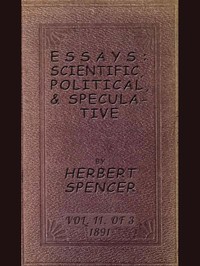
Essays: Scientific, Political, & Speculative; Vol. 2 of 3 Library Edition (1891), Containing Seven Essays not before Republished, and Various other Additions. — Story, Setting & Ideas
(0 User reviews)
449
Project Gutenberg
2016
Not confirmed
Science; Philosophy; Political science
Readers of public-domain and historical texts
Project Gutenberg digital edition
en
Edition facts
Words
165,837
Reading time
722 min
Text sections
41
Essays: Scientific, Political, & Speculative; Vol. 2 of 3 Library Edition (1891), Containing Seven Essays not before Republished, and Various other Additions. — Story, Setting & Ideas can be approached with a clearer sense of reading commitment from its source measurements: 165,837 words, 12 hr 2 min estimated reading time, and 41 detected text sections.
The text analysis averages about 26.9 words per sentence, while the detected sections provide another way to judge how the source is divided.
Project Gutenberg metadata also associates the work with “Science,” connecting these edition facts with the source record’s subject description.
Source:
Project Gutenberg record #53395
Herbert Spencer's second volume of essays examines the nature of scientific knowledge, classification of sciences, and philosophical debates, with precise attention to diction and argumentative structure. The excerpts reveal Spencer's method of refining definitions and addressing critics through careful qualification.
Read the complete public-domain text at its original source.
Read on Project GutenbergHerbert Spencer opens 'The Genesis of Science' by challenging the prevailing notion that scientific knowledge differs in nature from ordinary knowledge. He argues that both employ the same faculties and modes of operation, asserting that science is 'organized knowledge' and 'prevision.' Spencer's diction is deliberate: he uses terms like 'colligated,' 'inferences drawn,' and 'results expected' to emphasize the systematic organization underlying even common actions. This essay, first published in 1854, sets the tone for the volume's sustained examination of how knowledge is structured and validated.
Diction and the Definition of Science
Spencer's choice of words reveals his effort to redefine science against common misconceptions. In 'The Genesis of Science,' he writes that 'science is organized knowledge' and 'prevision,' but immediately qualifies these definitions by noting that all knowledge is organized to some degree, and that even a child's knowledge of an apple involves previsions. This rhetorical move—offering a definition only to expand it—is characteristic of Spencer's method. He uses terms like 'colligated' and 'inferences drawn' to bridge everyday reasoning and scientific method. The essay's opening paragraph contrasts 'the achievements of science' with 'daily unmethodic thinking,' yet insists the distinction is 'superficial.' Spencer's diction here is precise: he avoids absolutes, preferring 'vague notion' and 'superficial distinction' to leave room for nuance. This careful language sets up his broader argument that science is continuous with ordinary cognition, not a separate realm.
Argumentative Structure and Self-Correction
In 'Replies to Criticisms,' Spencer demonstrates a distinctive argumentative structure: he presents a critic's objection, acknowledges an 'apparent inconsistency,' and then refines his own phrasing. For instance, when Mr. Sidgwick points out a seeming contradiction about consciousness, Spencer admits he 'ought to have said' something different, substituting a more precise statement. He writes that the original wording was a 'defective expression,' not a fundamental error. This pattern recurs: Spencer quotes his critic, italicizes the disputed phrase, and then offers a corrected version. He distinguishes between 'a cognition' and 'what we call a cognition,' emphasizing relative versus absolute cognition. This self-correcting style reveals Spencer's commitment to precision and his willingness to adjust language to avoid misinterpretation. The structure—criticism, admission, clarification—makes his argumentative process transparent.
The Role of Examples in Philosophical Exposition
Spencer frequently uses concrete examples to anchor abstract claims. In 'The Genesis of Science,' he illustrates the idea that all knowledge involves organization by referencing 'the commonest actions of the household and the field.' He writes that these actions 'presuppose facts colligated, inferences drawn, results expected.' Similarly, in his response to Sidgwick, he introduces an analogy: 'There is no direct resemblance whatever between the sizes, forms, colours, and arrangements, of the figures in an account-book' and the actual transactions they represent, yet the book 'guides us correctly.' This example clarifies his distinction between relative and absolute cognition. Spencer's examples are drawn from everyday life—household tasks, account-books, a child's knowledge of an apple—rather than specialized scientific cases. This choice makes his philosophical points accessible and reinforces his claim that scientific reasoning is an extension of ordinary thought.
Voice and the Handling of Criticism
Spencer's authorial voice in the 'Replies to Criticisms' is measured and analytical, even when defending his positions. He refers to his critics by name—Mr. Sidgwick, Prof. Green—and quotes them at length, then responds point by point. His tone is not combative but corrective; he writes of 'an apparent inconsistency' and 'a defective expression' rather than accusing his critics of misunderstanding. He uses phrases like 'I ought to have said' and 'if Mr. Sidgwick will substitute this statement' to propose revisions. This voice reflects a commitment to clarity over polemic. Spencer also employs italics for emphasis, as when he distinguishes 'a cognition' from 'what we call a cognition.' His sentences are often complex, with multiple clauses and qualifications, mirroring the intricate reasoning he engages in. The overall effect is that of a thinker carefully refining his ideas in public dialogue.
Readers approaching this volume will find that Spencer's essays reward close attention to his word choices and argumentative moves. His habit of defining terms only to complicate them, his willingness to correct his own phrasing, and his use of everyday examples all contribute to a distinctive philosophical style. The essays are best read as demonstrations of method as much as statements of doctrine.
That afternoon, rain ticking the window, I let Spencer’s careful qualifications slow my reading, each definition polished like a stone. His insistence on precise boundaries felt like a form of patience I lacked. Later, restless, I pulled down Franklin’s volume—not for argument, but for its plain, meandering common sense. The Complete Works in Philosophy, Politics and Morals of the late Dr. Benjamin Franklin, Vol. 1 [of 3] — Background and Themes sat quietly beside Spencer, and somehow, the two talked.
There are no reviews for this eBook.
There are no comments for this eBook.
Reader reflection
Take a moment to reflect on this book
Create a short personal record of your experience with this book.
Your progress
0
/
10
2
How much did you enjoy the reading experience?
3
How likely are you to recommend this book?
4
How easy was the book to follow?
5
Did the story or argument move comfortably?
6
How closely did the book connect with your experience?
7
How distinctive were its ideas or approach?
8
Did you gain anything practical from the text?
9
What did this book teach you most?
10



![Cover of The Complete Works in Philosophy, Politics and Morals of the late Dr. Benjamin Franklin, Vol. 1 [of 3] — Background and Themes](https://yervu.com/storage/media/covers/pg48136.jpg)
![Cover of The Complete Works in Philosophy, Politics and Morals of the late Dr. Benjamin Franklin, Vol. 3 [of 3] — Text and Context](https://yervu.com/storage/media/covers/pg48138.jpg)