1

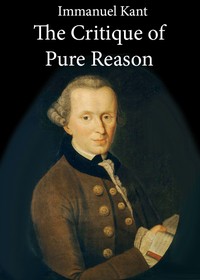
The Critique of Pure Reason — A Closer Reading
(0 User reviews)
1261
Project Gutenberg
2003
Not confirmed
Knowledge, Theory of; Causation; Reason; Philosophy, German
Readers of public-domain and historical texts
Project Gutenberg digital edition
en
Edition facts
Words
213,635
Reading time
929 min
Text sections
22
The Critique of Pure Reason — A Closer Reading can be approached with a clearer sense of reading commitment from its source measurements: 213,635 words, 15 hr 29 min estimated reading time, and 22 detected text sections.
The text analysis averages about 35.6 words per sentence, while the detected sections provide another way to judge how the source is divided.
Project Gutenberg metadata also associates the work with “Knowledge, Theory of,” connecting these edition facts with the source record’s subject description.
Source:
Project Gutenberg record #4280
Kant's 1781 Critique of Pure Reason, in Meiklejohn's translation, systematically examines the limits of human reason through dense, architectonic prose. The text distinguishes a priori from empirical knowledge, analyzes space and time as forms of intuition, and argues that categories like substance apply only to experience, not transcendent realities.
Read the complete public-domain text at its original source.
Read on Project GutenbergKant opens the Critique of Pure Reason with a striking claim: though all knowledge begins with experience, it does not all arise from experience. This distinction between the empirical and the a priori sets the stage for a work that proceeds with relentless architectural symmetry. The translator, J. M. D. Meiklejohn, renders Kant's German into a formal, Latinate English that mirrors the original's systematic rigor. Readers encounter long, hypotactic sentences that pile up qualifications, as in the discussion of the “I think” as an empirical proposition that nevertheless precedes experience. The text's structure—divided into Transcendental Æsthetic, Analytic, and Dialectic—reflects Kant's effort to map the faculties of sensibility, understanding, and reason. The prose is not ornamental; every clause serves the argument.
Architecture of the Argument
The Critique is built like a treatise on method, with numbered sections, subsections, and a table of contents that reads like a blueprint. Kant announces his project in the Preface to the First Edition (1781) and revises it in the Second (1787). The Introduction lays out key terms: pure versus empirical knowledge, analytic versus synthetic judgments, and the need for a science that determines the possibility and limits of a priori cognition. The Transcendental Æsthetic then examines space and time as pure forms of intuition, not properties of things in themselves. Each section follows a predictable pattern: metaphysical exposition, transcendental exposition, conclusions. This repetitive structure reinforces the argument but can feel mechanical. Meiklejohn’s translation preserves the original’s numbered paragraphs and marginal headings, helping readers track the logical scaffolding.
The Weight of the Sentence
Kant’s prose is famously dense, and Meiklejohn does not lighten it. Sentences often exceed fifty words, embedding multiple subordinate clauses. For example, in the discussion of rational psychology, one sentence runs: “The unity of consciousness, which lies at the basis of the categories, is considered to be an intuition of the subject as an object; and the category of substance is applied to the intuition.” The effect is cumulative: the reader must hold several ideas in mind while the argument unfolds. Kant frequently uses paired contrasts—a priori vs. a posteriori, analytic vs. synthetic, phenomenon vs. noumenon—and Meiklejohn marks these with italicized Latin terms. The vocabulary is abstract: “synthetical unity of apperception,” “transcendental deduction,” “manifold of representations.” There is little concrete imagery; the text operates entirely in the realm of concepts.
Pace and the Reader’s Burden
The Critique is not a book to be read quickly. Its 213,635 words are distributed across 22 text sections, but the density of argument means that a single paragraph can require several re-readings. Kant himself acknowledges this difficulty: in the Preface he warns that the work demands “patient and continuous reflection.” The pace varies: the Transcendental Æsthetic is relatively brisk, defining space and time in a few dozen pages; the Analytic slows to a crawl as Kant deduces the categories and explains the principle of apperception. The Dialectic, which critiques rational psychology and cosmology, picks up speed again, but the arguments become more intricate. Meiklejohn’s translation, with its archaic diction (“cogitate,” “sensuous intuition”), adds an additional layer of difficulty. Readers may find it helpful to read aloud or to paraphrase each paragraph before moving on.
Approach this edition as a working text, not a finished monument. Meiklejohn’s translation, while faithful, is one of several; comparing it with later versions (e.g., Kemp Smith or Guyer/Wood) can illuminate interpretive choices. The Project Gutenberg text lacks the original’s pagination (A/B edition numbers), so readers seeking to follow scholarly references will need a print edition. The Critique rewards slow, iterative reading: treat each section as a self-contained argument, and do not hesitate to backtrack. The effort is repaid by a clearer understanding of how Kant reshaped philosophy.
I finished Kant’s Critique of Pure Reason weeks ago, and still catch myself wondering how much of what we see is really there. That same quiet ache of uncertainty followed me through Plato’s Gorgias — Edition Insights. Both feel less like answers and more like honest company for troubled thinking. I think of them often, like old friends whose questions I haven’t outgrown.
There are no reviews for this eBook.
There are no comments for this eBook.
Reader reflection
Before you leave, reflect on the book
Use these questions to collect your thoughts before moving on.
Your progress
0
/
10
2
Did this book hold your interest?
3
Would you encourage someone else to read it?
4
What was the reading difficulty like?
5
How did the pace of the book feel?
6
What was the strongest part of the book?
7
How useful did the reading feel?
8
How clearly were the main ideas presented?
9
Which lesson or insight stayed with you?
10
![Cover of The Complete Works in Philosophy, Politics and Morals of the late Dr. Benjamin Franklin, Vol. 1 [of 3] — Background and Themes](https://yervu.com/storage/media/covers/pg48136.jpg)
![Cover of The Complete Works in Philosophy, Politics and Morals of the late Dr. Benjamin Franklin, Vol. 3 [of 3] — Text and Context](https://yervu.com/storage/media/covers/pg48138.jpg)