1

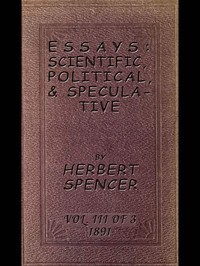
Essays: Scientific, Political, & Speculative; Vol. 3 of 3 Library Edition (1891), Containing Seven Essays not before Republished, and Various other Additions. — A Closer Reading
(0 User reviews)
771
Project Gutenberg
2017
Not confirmed
Science; Philosophy; Political science
Readers of public-domain and historical texts
Project Gutenberg digital edition
en
Edition facts
Words
182,403
Reading time
794 min
Text sections
33
This digital edition of Essays: Scientific, Political, & Speculative; Vol. 3 of 3 Library Edition (1891), Containing Seven Essays not before Republished, and Various other Additions. — A Closer Reading is described by source-level measurements including 182,403 words, 13 hr 14 min estimated reading time, and 33 detected text sections.
The text analysis averages about 24.4 words per sentence, while the detected sections provide another way to judge how the source is divided.
Project Gutenberg metadata also associates the work with “Science,” connecting these edition facts with the source record’s subject description.
Source:
Project Gutenberg record #54076
Herbert Spencer's third volume of essays examines manners, fashion, railway policy, trade morals, prison ethics, and political philosophy through a lens of evolutionary social theory, using concrete observations and analogies to argue against state intervention.
Read the complete public-domain text at its original source.
Read on Project GutenbergHerbert Spencer opens this volume by linking political dissent to sartorial nonconformity, noting that at a Chartist demonstration or socialist lecture, one sees 'many among the audience' with 'oddities in form and colour'—hair parted down the centre, beards, waistcoats cut Quaker fashion. This observation is not mere description; it launches a method that recurs throughout the collection: Spencer reads social phenomena as symptoms of deeper principles. The essays, written between 1854 and the 1880s, apply evolutionary reasoning to ethics, politics, and economics. Spencer's prose is deliberate, building arguments through analogy—comparing state intervention to a mother who ties her child's pinafore, gradually fostering helplessness. The volume includes seven essays not previously republished, and its tone is consistently forensic, even when the subject is as seemingly trivial as hat styles.
Dress as Political Signal
In 'Manners and Fashion,' Spencer treats clothing as a text of political allegiance. He observes that at radical gatherings, 'the black cylinders which tyrannize over us' are replaced by caps and felt hats. The detail is precise: he notes 'a sprinkling of moustaches,' 'an imperial,' and 'occasionally some courageous breaker of conventions exhibits a full-grown beard.' This is not mere cataloguing; Spencer uses the uniformity of mainstream dress to argue that fashion operates as a system of social control. He writes that even those without conspicuous peculiarities 'frequently indicate by something in the pattern of their clothes, that they pay small regard to what their tailors tell them about the prevailing taste.' The essay thus establishes a pattern: Spencer treats surface details as evidence of underlying social forces, a method he will apply to railways, prisons, and parliamentary reform.
The Nursery as Political Laboratory
In 'Over-Legislation,' Spencer extends his argument against state action by invoking domestic discipline. He imagines a 'thoughtless mother who hourly yields to the requests—"Mamma, tie my pinafore," "Mamma, button my shoe"' and warns that each concession, though trivial, 'will end in inaptitude.' The analogy is central to Spencer's method: he treats the family as a miniature society subject to the same laws of adaptation. He contrasts the 'teacher of the old school who showed his pupil the way out of every difficulty' with the modern teacher who 'induces his pupil to solve his difficulties himself.' The passage is striking for its concrete, almost homely imagery—pinafores, shoes, nurseries—deployed in service of a sweeping political philosophy. Spencer insists that 'all national character is gradually produced by the daily action of circumstances,' and that the cumulative effect of small interventions is national enervation.
The Machinery of Misunderstanding
Spencer's critique of legislative complexity appears in his discussion of mercantile marine law, where he notes the 'complexity to which this process of adding regulation to regulation—each necessitated by foregoing ones—ultimately leads.' He quotes Guizot on the 'gross delusion' of 'a belief in the sovereign power of political machinery,' a delusion he sees as fostering revolution. The phrasing is characteristic: Spencer distrusts abstraction and prefers to trace how one intervention breeds another. He argues that each new regulation creates misunderstandings, delays, and disputes that 'greatly hamper our social life.' This is not a blanket rejection of all law but a warning against the self-perpetuating logic of state expansion. The essay 'Over-Legislation' builds its case through accumulation of such examples, each drawn from a different domain—navigation law, banking, parliamentary reform—creating a mosaic of unintended consequences.
Adaptation and Its Limits
Throughout the volume, Spencer returns to the concept of adaptation: individuals and nations become fitted to their conditions. In 'Over-Legislation,' he asks: 'Is it not true of the drunkard, that each carouse adds a thread to his bonds? of the trader, that each acquisition strengthens the wish for acquisitions? of the pauper, that the more you assist him the more he wants?' The parallel structure drives home a deterministic view: human nature is plastic, and state assistance reshapes it toward dependence. Spencer extends this to national character, arguing that 'just in proportion as its members are little helped by extraneous power they will become self-helping, and in proportion as they are much helped they will become helpless.' The argument is consistent across essays: in 'Prison-Ethics,' in 'The Morals of Trade,' in 'Railway Morals and Railway Policy,' the same logic applies. Spencer's voice is that of a system-builder, but his evidence is always particular, drawn from the details of Victorian life.
Readers approaching this volume should attend to Spencer's method of argument: he moves from concrete observation—a Chartist's beard, a child's pinafore, a railway regulation—to general principle. The essays reward attention to his analogies, which are not decorative but structural. Spencer rarely asserts without illustrating, and his illustrations are drawn from the everyday world of Victorian Britain: nurseries, tailors, parliament, the stock exchange. This grounding in the particular gives his polemics a texture that abstract philosophy lacks. The volume is best read as a series of demonstrations of a single method, applied to diverse subjects.
I found myself thinking about Spencer’s quiet warnings against heavy‑handed reform, then drifted to Franklin’s plain‑spoken practicality in The Complete Works in Philosophy, Politics and Morals of the late Dr. Benjamin Franklin, Vol. 3 [of 3] — Text and Context. Both men, in their own unhurried way, trusted ordinary sense over grand schemes. That humbled me a little, and made me read more slowly.
There are no reviews for this eBook.
There are no comments for this eBook.
Reader reflection
Record your reading impressions
A brief reflection can help important ideas stay with you longer.
Your progress
0
/
10
2
How did the book work for you overall?
3
How likely are you to recommend this book?
4
How demanding did the text feel?
5
Would a second reading be valuable?
6
Did the book give you something worth debating?
7
Was the book easy to understand?
8
What was the strongest part of the book?
9
What is the main idea you are taking away?
10



![Cover of The Complete Works in Philosophy, Politics and Morals of the late Dr. Benjamin Franklin, Vol. 1 [of 3] — Background and Themes](https://yervu.com/storage/media/covers/pg48136.jpg)
![Cover of The Complete Works in Philosophy, Politics and Morals of the late Dr. Benjamin Franklin, Vol. 3 [of 3] — Text and Context](https://yervu.com/storage/media/covers/pg48138.jpg)